
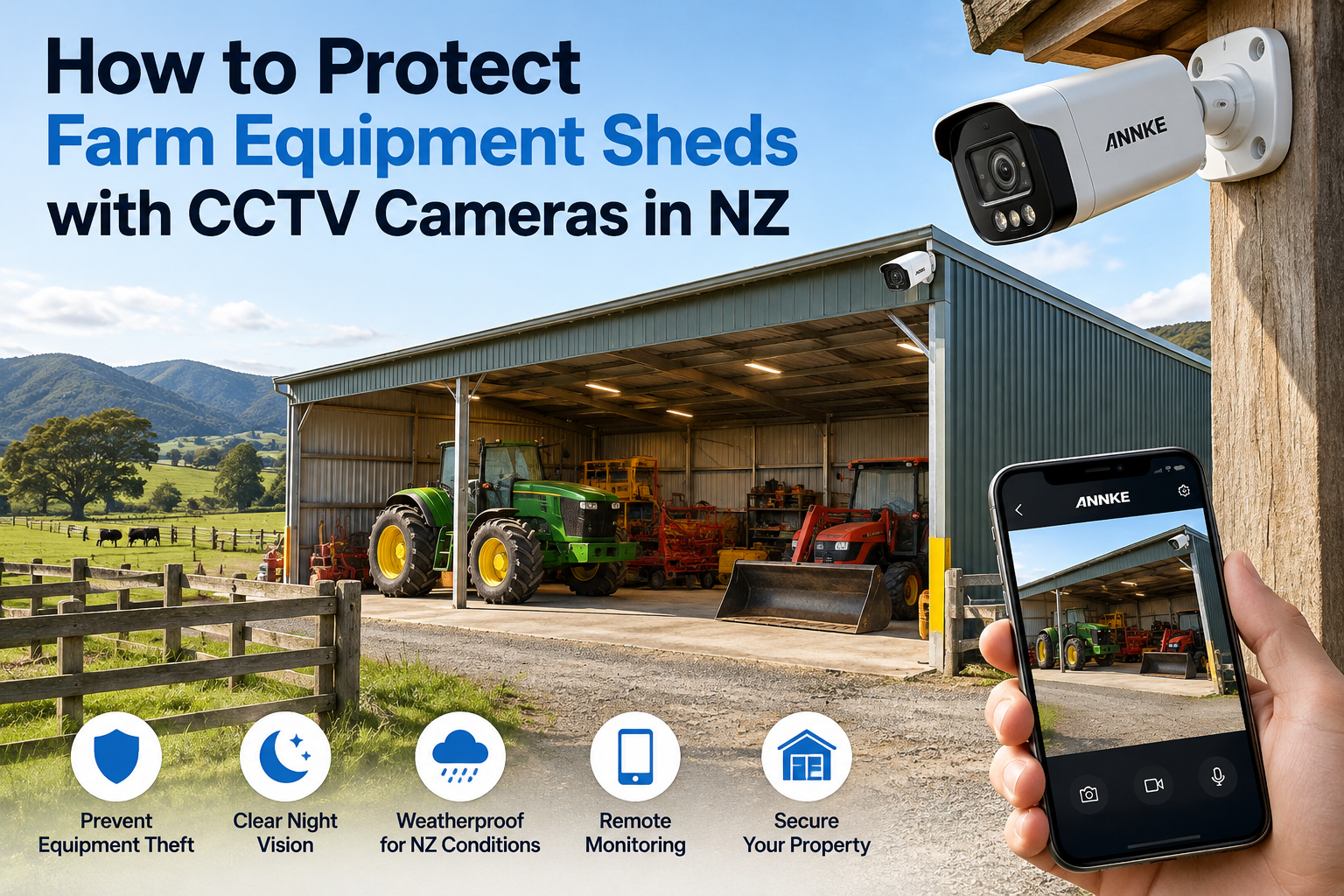
A quad bike gone from the implement shed. A chainsaw missing before calving starts. Diesel siphoned from the tank overnight. If you farm in New Zealand, you have probably lived one of these, or heard about it at the saleyards. The right farm shed security cameras won’t make your place theft-proof, but a well-planned system makes it a harder target, alerts you while something is still happening, and gives Police footage they can actually use.
This guide covers how to plan coverage for a working farm, which camera features matter in rural conditions, how to get power and data to a shed 200 metres from the house, and the privacy rules that apply once your farm is a business. It is written for farmers, lifestyle block owners and anyone with machinery parked away from the house.
Why farm sheds are such easy targets
Rural crime in New Zealand is common and under-reported. In Federated Farmers’ 2023 Rural Crime Survey of more than 1,000 farmers, 67% said they had experienced or suspected a crime in the previous two years, and about a third reported property theft (Farmers Weekly coverage of the survey). Nearly half of those affected had not reported it to Police.
The shed is usually where the loss happens. Thieves go for items that are portable, valuable and easy to sell on:
- Quad bikes, farm bikes and side-by-sides
- Chainsaws, generators, welders and power tools
- Fencing gear and electric fence energisers
- Diesel and petrol from on-farm tanks
Three things make sheds vulnerable. They sit away from the house, often out of sight and earshot. They are left open during the working day, when farm thefts also happen. And keys often stay in vehicles because it is convenient. Cameras address the first problem directly and support you on the other two.
How to plan farm shed CCTV coverage, step by step
Most disappointing farm CCTV setups fail at the planning stage, not because of the camera. A camera pointed at the general shed area at night records a blur. A camera at the one gate every vehicle must pass records a number plate. Work through these steps before you buy anything.
- List what you are protecting and where it lives. Walk the property with a notepad. Note the implement shed, workshop, fuel tank, calf shed, bike parking and any yard where machinery sits overnight.
- Find the choke points. Most farms have one or two ways a vehicle can get in and out: the road gate, a race, a bridge. A camera covering the route in catches far more than one covering a wide yard.
- Decide what each camera must capture. Be specific. “See movement” needs little. “Identify a face at the shed door” needs the camera close. “Read a number plate at the gate” needs a narrow field of view or optical zoom.
- Measure distances. Note how far each spot is from the house, the nearest power and the router. This decides your cabling and power options (covered below).
- Choose detection and alert zones. Plan to alert on people and vehicles near sheds after hours, and ignore the paddock where stock move all night.
- Plan where footage lives. A network video recorder (NVR) in the house keeps recordings off-site from the shed. A thief who rips down a camera can’t take the footage with them.
- Budget for it in stages. Start with the highest-value shed and the entry route, then add cameras as you learn what you need.
Choosing outdoor security cameras for farms: what actually matters
Spec sheets are long. For farm equipment security cameras, these are the features that change the outcome.
Resolution matched to distance
Higher resolution lets you zoom into recorded footage and still make out detail. A 4K (8MP) camera gives more usable detail at range than a 1080p camera. But resolution can’t replace placement: a 4K camera 40 metres from a shed door still won’t reliably identify a face. Use wide cameras for overview, and closer or zoom cameras for identification.
Night performance
Most farm theft worth recording happens in the dark, with no streetlights for kilometres. Look for:
- Infrared (IR) night vision, which records in black and white in total darkness
- Colour night vision with a large aperture (around F/1.6) that captures colour in very low light. Colour helps describe a vehicle or clothing to Police
- Dual-light or white-light models, which switch on a spotlight when a person is detected
Smart detection, not just motion
Basic motion detection on a farm is close to useless. Wind, rain, possums, dogs and stock will trigger alerts all night until you switch them off. Human and vehicle detection filters most of that out, so the alert on your phone at 2am means something.
Active deterrence
Some outdoor cameras include a built-in siren and strobe light, triggered when a person enters a zone you’ve drawn. On an isolated shed this can push an opportunist away before anything is taken. The ANNKE AC800 4K outdoor camera is one example, with a siren, strobe, two-way audio and human and vehicle detection.
Optical zoom for long views
A varifocal lens lets you narrow the view after installation, which suits gateways and long driveways. The ACZ800 4K camera with 4x optical zoom has a 2.8–12mm motorised lens for this kind of job.
Weather and impact rating
NZ farm conditions mean rain, wind, dust and spray. Choose an IP67 rating for outdoor mounting. An IK10 rating adds resistance to someone hitting the camera, which helps in exposed spots.
Power and connectivity for rural property security cameras NZ
This is the question that separates farm CCTV from suburban CCTV. Your shed may be hundreds of metres from the house, with no Wi-Fi and patchy cellular coverage. Pick the connection method before you pick cameras.
| Option | Best for | Distance | Watch out for |
|---|---|---|---|
| PoE cable to an NVR | Sheds near the house or with power on site | Up to 100 m per cable run | Bury or sleeve cable; stock and rats chew exposed runs |
| PoE switch in the shed + fibre or long cable back | Sheds with mains power, further out | Fibre covers far beyond 100 m | Needs a weatherproof enclosure and mains power at the shed |
| Point-to-point wireless bridge | Sheds with line of sight to the house | Hundreds of metres to kilometres | Trees, hills and buildings block the link |
| Solar + 4G camera | Remote sheds, fuel tanks, gates with no power | Anywhere with cellular signal | Data plan costs; limited recording in long dark winters |
| Wi-Fi camera | Small lifestyle blocks with good Wi-Fi at the shed | Usually only tens of metres | Drops out at range; easy to jam or unplug |
For most working farms, a wired Power over Ethernet (PoE) system is the most reliable choice. One cable carries both power and video, so there is no battery to charge and no Wi-Fi to drop out. Cameras record continuously to the NVR in the house. The ANNKE PoE security systems range bundles cameras with a matching NVR, which makes the first install simpler.
If the shed is too far for a single cable run, a PoE switch at the shed plus a wireless bridge or fibre link back to the house extends the same wired system. Any new mains circuit to a shed should be installed by a registered electrician.
For very remote sheds with no power or cabling at all, battery and solar-powered cameras are the fallback. Land Watch NZ’s guide on how to choose the right security system for your farm walks through those power options alongside Wi-Fi, trigger speed and camera placement.
Farm shed CCTV installation: practical tips
Good placement matters more than the price of the camera. These habits make the biggest difference on a farm.
- Mount high, angle down. Around 2.5–3.5 metres keeps the camera out of easy reach while still capturing faces. Too high and you only record the tops of heads and hoods.
- Cover both sides of the door. One camera inside the shed and one outside on the approach is better than two angles on the same spot.
- Keep the sun out of the lens. A camera facing east or west will flare at sunrise or sunset. Check the view at different times of day before you fix it in place.
- Protect the cabling. Run cable inside conduit, inside the shed frame, or underground. Exposed cable is easy to cut and easy for rats to chew.
- Use a UPS for the NVR. A small uninterruptible power supply keeps recording during a power cut, which is when some thieves strike.
- Light the area. Sensor lights make colour footage far better and are a deterrent on their own.
- Test at night before you finish. Walk the approach in the dark wearing a hoodie and check what the footage actually shows.
Common mistakes to avoid
- Pointing a single wide camera across a whole yard and expecting to identify anyone.
- Leaving motion alerts on for everything, getting 50 notifications a night, and then switching alerts off entirely.
- Keeping the NVR in the shed you are protecting.
- Never checking the system. Cameras get knocked, spiders build webs over lenses, and hard drives fill. Schedule a monthly check.
- Forgetting to change default passwords and update firmware on networked cameras.
Privacy rules for farm CCTV cameras in NZ
This is the part most guides skip, and it matters for farms. A person filming their own home is not usually covered by the Privacy Act 2020 unless the filming is highly offensive. A farm run as a business is different. The Office of the Privacy Commissioner says businesses and organisations can only collect footage that is necessary for a purpose connected to their activities, and must let people know cameras are operating (Privacy Commissioner guidance on CCTV).
In practice, for a farm business with staff, contractors or visitors, that means:
- Have a clear purpose. Protecting equipment, fuel and stock from theft is a legitimate one. Write it down.
- Put up signs at entrances and on monitored sheds. Signs also deter.
- Tell your staff where the cameras are and why, ideally in writing.
- Keep cameras out of private areas such as staff accommodation, bathrooms and changing areas.
- Don’t point cameras into a neighbour’s house or yard.
- Be ready for access requests. People have a right to ask for footage of themselves.
- Don’t keep footage longer than you need it, and don’t post it online. Give it to Police instead.
Audio recording raises the privacy stakes further, so many businesses leave microphones switched off unless they have a specific reason. This section is general information, not legal advice.
Cameras work best as one layer of farm security
Cameras record and alert. They don’t lock a door. The farms that lose least combine CCTV with simple physical habits:
- Lock sheds, fuel tanks and workshop doors when no one is working nearby.
- Take keys out of bikes, utes and machinery, every time.
- Keep an inventory with serial numbers and photos. It makes recovery and insurance claims easier.
- Mark tools and machinery with an identifying number.
- Join or start a local rural crime prevention or Neighbourhood Support group, and share footage of suspicious vehicles with Police.
- Report every incident and suspicious vehicle to Police, even small ones. Reports help Police see patterns and allocate rural resources.
The same layered thinking applies to other remote, high-value sites. Frontline Security’s guide to choosing construction site security cameras makes a similar case: cameras are most effective inside a wider security plan, and solar or wireless options suit sites without permanent power.
Frequently asked questions
What is the best security camera setup for a farm shed in NZ?
For most farms, a wired PoE camera system with an NVR in the house is the most reliable setup. Use human and vehicle detection, good night vision and an IP67 weather rating. Add a zoom camera at the main entrance to capture number plates.
Can security cameras work on a farm without Wi-Fi?
Yes. PoE cameras send video over a network cable to a recorder, so they don’t need Wi-Fi. For sheds far from the house, a point-to-point wireless bridge or fibre link can connect them. Solar and 4G cameras work where there is no power or cabling.
How many cameras do I need for a farm shed?
Most single sheds need two: one covering the approach and doors from outside, and one inside covering the machinery. Add one for the main property entrance and one for any fuel tank.
How far can a PoE security camera be from the recorder?
A standard Ethernet cable run is limited to about 100 metres. For longer distances, use a PoE switch at the shed linked back to the house by fibre or a wireless bridge.
Do I need signs for CCTV on my farm?
If your farm operates as a business, the Privacy Commissioner expects organisations to make people aware that cameras are operating, and signs are the usual way. Signs also act as a deterrent.
Will cameras stop farm theft?
No camera stops every theft. Visible cameras, sirens and lights deter opportunists, and alerts give you time to respond. Clear footage also gives Police better evidence to act on.
Protect your sheds with a plan, not just a camera
The most effective farm shed security cameras in NZ are the ones placed with a purpose: covering the way in, identifying people and vehicles at the shed door, and alerting you only when it matters. Get power and connectivity sorted first, keep the recorder away from the shed, follow the Privacy Act if you run the farm as a business, and back the cameras up with locks, lights and good habits.
Ready to plan your setup? Browse the full range of outdoor CCTV cameras, NVRs and PoE kits at ANNKE NZ and start with the shed that would hurt most to lose.



 No products in the cart.